
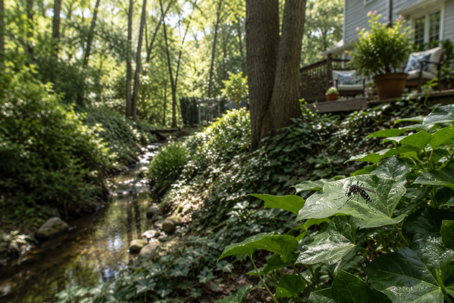
Why Creekside and Wooded Atlanta Yards Can Have More Mosquitoes in Late Summer
Late August around Atlanta can be a confusing time for homeowners dealing with mosquitoes. Summer is beginning to wind down, school is back in session, and fall is technically getting closer. Yet in many wooded neighborhoods around Alpharetta, Milton, Marietta, Roswell, and other North Atlanta communities, mosquito activity can still feel extremely heavy.
For some properties, the reason has less to do with one obvious bucket of standing water and more to do with the way the entire yard is situated.
Atlanta’s rolling terrain, tree-lined neighborhoods, creek corridors, drainage swales, dense shrubs, ivy, and shaded backyards can create excellent mosquito habitat. A property sitting lower than the homes around it or backing up to a wooded creek may experience noticeably more mosquito activity than another home only a few streets away.
Understanding why these environments attract mosquitoes can also help homeowners know where to focus prevention efforts during the final stretch of summer.
Does Living Near a Creek Cause More Mosquitoes?
Possibly, but not for the reason many homeowners assume.
Mosquito larvae need standing or very slow-moving water to develop. A healthy, flowing creek itself is generally not the same type of breeding habitat as a stagnant bucket, clogged gutter, or shallow pool of rainwater.
The areas around a creek can be a different story.
Creek bottoms and flood-prone areas often contain low spots where water remains after rain. Overflow areas, drainage channels, tree holes, discarded containers, blocked culverts, and shallow depressions can all hold water long enough for mosquitoes to complete their aquatic development.
The University of Georgia Cooperative Extension specifically notes that Asian tiger mosquito populations often seem most abundant in the lower portions of neighborhoods, particularly around creek bottoms and drainage swales.
So if your Atlanta backyard slopes down toward a creek, drainage easement, or wooded lowland, the creek may be part of the larger environment contributing to mosquito pressure even if mosquitoes are not developing directly in the moving water.
Atlanta's Rolling Terrain Can Concentrate Water in Certain Yards
One thing that makes Atlanta mosquito problems different from flatter coastal communities is the terrain.
Many neighborhoods throughout Alpharetta, Milton, Marietta, Roswell, and surrounding areas are built across hills and wooded slopes. When heavy summer rain falls, water naturally moves downhill.
That means one property may drain quickly while another lot farther downhill receives runoff from several surrounding yards.
Water can collect in:
Drainage swales
Low spots in lawns
French drains
Catch basins
Ditches
Areas beneath decks
Landscape beds
Tree holes
Clogged storm drains
Containers hidden beneath vegetation
Even if those areas eventually dry, they may remain wet long enough for mosquitoes to develop.
According to UGA's mosquito biology guidance, mosquito larvae and pupae generally need water for about seven days or more to complete development. During warm weather, development can happen particularly quickly.
That makes late-summer rain especially important. Water does not have to remain for weeks to create a mosquito problem.
Why Wooded Atlanta Yards Give Adult Mosquitoes a Place to Hide
Water explains where mosquitoes develop, but it does not explain where the adults spend the rest of their time.
Adult mosquitoes commonly seek out cool, humid, shaded places during the heat of the day.
Atlanta’s mature tree canopy creates an abundance of these resting areas. Dense shrubs, hedges, groundcover, ivy, wooded fence lines, and vegetation along creeks can all provide protected mosquito habitat.
UGA specifically identifies privet thickets and thick groundcover such as English ivy as areas associated with heavy Asian tiger mosquito activity.
That is important because Asian tiger mosquitoes are one of the most common nuisance mosquitoes in Georgia. They are aggressive daytime biters, so homeowners do not necessarily have to wait until sunset to notice them.
A sunny front yard may feel relatively comfortable while the wooded backyard behind the house has noticeably heavier mosquito activity.
Why Late August Can Make the Problem Feel Worse
By late August, Atlanta mosquito populations have had an entire summer to build.
Warm temperatures allow mosquitoes to develop quickly, while repeated thunderstorms continually create new water sources throughout residential neighborhoods.
UGA notes that under ideal warm conditions, the mosquito larval stage can take as little as five to six days, followed by another two to three days in the pupal stage before an adult emerges. Learn more about mosquito development around Georgia homes here.
That means a rain event in the middle of August can contribute to a new group of adult mosquitoes before the end of the month.
At the same time, the dense vegetation around wooded Atlanta properties provides plenty of shelter for the adults once they emerge.
Late August therefore combines two favorable conditions: ongoing mosquito reproduction and months of established adult habitat.
Why Your Backyard May Be Worse Than the Front Yard
Many Atlanta homeowners notice a very specific pattern: the front of the house is manageable, but the backyard is miserable.
There is usually a reason.
Front yards often receive more direct sunlight, airflow, and regular landscaping. Backyards may be bordered by woods, fences, drainage areas, creeks, or dense vegetation.
Mosquitoes prefer the protected side.
A backyard surrounded by mature trees and thick shrubs can maintain higher humidity and lower temperatures than an exposed lawn. Those conditions allow mosquitoes to remain protected during hot afternoons.
This is also why simply treating one puddle or removing one container may not immediately solve a mosquito problem. The adults already living around the property still have plenty of suitable places to rest.
What About Retention Ponds and Drainage Areas?
Atlanta-area subdivisions often contain retention ponds, detention basins, stormwater channels, and other systems designed to handle runoff.
These systems are necessary, but homeowners sometimes assume the entire pond is automatically responsible for every mosquito in the neighborhood.
That is not always the case.
Established ponds with deeper open water may contain fish, insects, and other predators that consume mosquito larvae. The more productive mosquito habitat is often found around shallow edges, clogged drains, temporary puddles, dense vegetation, or nearby containers.
Drainage systems also become more problematic when water remains stagnant for extended periods.
The larger lesson is that mosquito habitat is often found in the small, protected places surrounding water rather than in the most obvious body of water itself.
What Atlanta Homeowners Can Do
Homeowners with wooded or creek-adjacent properties cannot change the entire surrounding landscape, but there are still several practical ways to reduce mosquito habitat close to the home.
After rainfall, walk through the property and check both the obvious and hidden areas.
Look for:
Water collecting in planters and saucers
Children's toys
Wheelbarrows and yard equipment
Tarps and outdoor furniture covers
Clogged gutters
Drainage structures that are not emptying properly
Water beneath decks
Containers hidden behind shrubs
Low areas of the lawn
Tree holes
Birdbaths
Pet bowls left outdoors
UGA recommends a simple "tip and toss" approach for removable water sources: empty the water and either dispose of the container or reposition it so it cannot refill. UGA's mosquito-control guide emphasizes eliminating standing water as the most important first step homeowners can take.
Don't Forget the Vegetation
Standing water gets most of the attention in mosquito prevention, but homeowners with heavily wooded properties should also think about adult resting habitat.
You do not need to strip the yard bare.
Instead, focus on keeping vegetation manageable around the outdoor areas you actually use.
That may include:
Trimming extremely dense shrubs
Reducing overgrown ivy or groundcover near patios
Keeping vegetation away from seating areas
Opening up excessively dense fence lines
Maintaining airflow around porches and decks
Removing unnecessary brush and yard debris
The goal is not to eliminate Atlanta’s tree canopy. It is to reduce some of the especially dense, humid pockets immediately around the home where mosquitoes are most likely to rest.
Why DIY Mosquito Products Can Be Frustrating in Wooded Yards
Wooded Atlanta properties can be particularly challenging for one-time mosquito products.
A homeowner may spray the patio and see temporary improvement, only to have mosquito activity return quickly.
The problem is often that the mosquitoes are not primarily sitting on the patio.
They may be resting several feet away inside shrubs, ivy, hedges, or vegetation along the edge of the property. New mosquitoes may also continue emerging from nearby standing water or moving into the yard from surrounding habitat.
That is why effective mosquito management usually requires addressing both the water mosquitoes need for development and the vegetation adult mosquitoes use for shelter.
How Torpedo Mosquito Treats Wooded Atlanta Properties
At Torpedo Mosquito, our treatments are designed around how mosquitoes actually use each property.
For wooded and creek-adjacent Atlanta homes, that means paying particular attention to shaded vegetation, shrubs, fence lines, groundcover, and other protected areas where adult mosquitoes are likely to rest.
Motorized backpack equipment allows treatment to penetrate dense vegetation more effectively than a light surface spray. UGA also notes that motorized backpack applications can provide better penetration into dense mosquito harborage than simple handheld applications.
We also look for potential breeding areas around the property and point out water sources that homeowners may be able to eliminate.
That combination matters because simply killing the mosquitoes flying around one afternoon does not prevent new adults from emerging later.
Regular service helps keep pressure lower over time, particularly during late summer when Atlanta’s heat, rain, and vegetation are all working in the mosquito's favor.
Frequently Asked Questions About Mosquitoes Around Wooded Atlanta Homes
Do creeks cause mosquitoes?
Flowing creek water is usually not ideal mosquito breeding habitat, but the areas surrounding creeks can hold standing water after rain. Creek bottoms, drainage swales, shallow pools, containers, and dense vegetation can all contribute to mosquito activity.
Why are mosquitoes worse at the bottom of my neighborhood?
Water naturally drains downhill, which can create wetter conditions in lower portions of neighborhoods. UGA also notes that Asian tiger mosquitoes are often especially common around creek bottoms and drainage swales.
Does ivy attract mosquitoes?
Ivy does not create mosquitoes by itself, but thick groundcover can provide cool, shaded, humid resting habitat for adult mosquitoes. UGA specifically identifies English ivy as one type of vegetation commonly associated with mosquito harborage.
Why is my wooded backyard worse than my sunny front yard?
Mosquitoes prefer shaded, humid, wind-protected areas. Dense trees and landscaping can create more favorable resting conditions than a sunny, open lawn.
Can mosquitoes breed in a flowing creek?
Mosquito larvae generally require standing or very slow-moving water. Moving creek water is less suitable, but stagnant pools along creek edges, flood areas, clogged drainage structures, and nearby containers can support mosquito development.
Can professional mosquito control help on a wooded property?
Yes. Professional treatment can target the shaded shrubs, groundcover, vegetation, and other resting areas adult mosquitoes use around wooded properties. Combining those treatments with standing-water reduction provides a more complete approach.
Late Summer Isn't the Time to Ignore a Wooded Backyard
Atlanta's wooded neighborhoods are part of what makes the area so appealing, but mature trees, rolling terrain, creeks, and lush landscaping can also create excellent mosquito habitat.
As August turns into September, warm temperatures and rainfall can continue supporting mosquito activity even while the calendar starts looking more like fall.
If your backyard backs up to a creek, wooded area, drainage easement, or dense vegetation, pay close attention to both water and shade. Empty unnecessary standing water, keep drainage systems functioning, and maintain the vegetation around your outdoor living areas.
And if mosquito activity remains heavy despite those efforts, Torpedo Mosquito provides residential mosquito control throughout Alpharetta, Milton, Marietta, Newnan, and surrounding Metro Atlanta communities. We tailor treatments to the property so that a wooded backyard is treated like a wooded backyard, not like every other lawn on the route.