
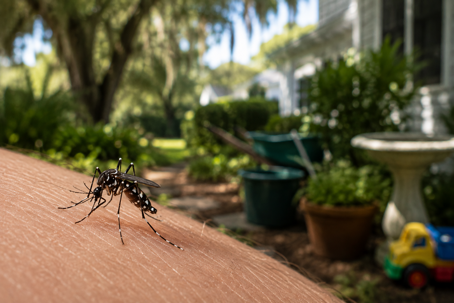
Getting Bitten During the Day in Savannah? Meet the Asian Tiger Mosquito
Most people associate mosquitoes with evenings. You expect to hear the buzzing start around sunset, reach for the bug spray before sitting on the porch, and assume the middle of the afternoon is relatively safe.
Then you step into your Savannah backyard at 2 p.m. and get bitten before you've even finished watering the plants.
If that sounds familiar, you may be dealing with one of the most common nuisance mosquitoes in Georgia: the Asian tiger mosquito.
These small black-and-white mosquitoes behave differently from many of the species homeowners are used to encountering. They are aggressive daytime biters, frequently live very close to homes, and can reproduce in surprisingly small amounts of water. By late August, after months of warm temperatures and summer rainfall, their populations can become especially noticeable throughout Savannah, Pooler, Richmond Hill, The Landings, and other communities across Chatham County.
Understanding how Asian tiger mosquitoes behave is important because controlling them requires looking much closer to home than many Savannah homeowners realize.
What Is an Asian Tiger Mosquito?
The Asian tiger mosquito (Aedes albopictus) is easy to distinguish from many other mosquitoes once you know what to look for. Adults are dark black with distinctive white markings on their bodies and legs, giving them the striped appearance that inspired their name.
The species was first identified in Georgia in the 1990s and has since become common throughout the state. University of Georgia Cooperative Extension identifies the Asian tiger mosquito as a common pest throughout Georgia, particularly around residential properties.
Unlike many mosquitoes that are most active around sunrise and sunset, Asian tiger mosquitoes readily bite throughout the daytime. They are especially active in shaded areas, which means homeowners can encounter them while gardening, playing with children outside, walking the dog, working around the yard, or relaxing near a shaded patio.
If you're regularly getting mosquito bites during the middle of the day in Savannah, Asian tiger mosquitoes are one of the first suspects worth considering.
Why Are Daytime Mosquitoes So Common Around Savannah Homes?
Asian tiger mosquitoes are particularly well adapted to residential environments.
Many coastal mosquitoes develop in marshes, wetlands, or other large natural habitats. Asian tiger mosquitoes take a very different approach. They prefer small water-holding containers, many of which are found directly around homes.
Chatham County Mosquito Control explains that Asian tiger mosquitoes commonly develop in containers scattered throughout residential properties. These can include obvious sources such as buckets and birdbaths, but they can also include surprisingly small or overlooked objects.
Common breeding sites around Savannah homes include:
Flowerpots and plant saucers
Children's toys
Pet water bowls
Birdbaths
Buckets
Wheelbarrows
Clogged gutters
Tires
Tarps and boat covers
Outdoor storage containers
Bottle caps and small discarded containers
Bromeliads and other plants that naturally hold water
Tree holes
Small pools and water-filled lawn equipment
A large pond is not required. If an object can hold rainwater for several days, it may provide enough habitat for mosquito larvae to develop.
These Mosquitoes Usually Aren't Coming From Miles Away
One of the most useful facts about Asian tiger mosquitoes is that they generally stay surprisingly close to where they develop.
According to Chatham County Mosquito Control, Asian tiger mosquitoes typically remain within approximately 300 feet of their emergence site. UGA similarly notes that Aedes albopictus generally flies only a few hundred feet, compared with some salt-marsh mosquitoes that can travel many miles.
For homeowners, that means persistent daytime mosquito activity often points to a source somewhere nearby.
It may be in your yard. It could be a neighboring property, drainage area, shared landscaping, or another small water source within the surrounding neighborhood.
That is very different from some of the coastal mosquitoes affecting Savannah, which may travel significant distances from marsh environments.
If you're repeatedly seeing striped mosquitoes biting throughout the day in the same area of your yard, it is worth taking a close look around the property.
Why Late August Is a Particularly Important Time to Look
By the end of August, Savannah mosquitoes have had months of ideal conditions.
Heat speeds mosquito development, summer rainfall repeatedly refills containers, and high humidity provides excellent conditions for adult mosquitoes. Chatham County reports that Asian tiger mosquitoes can emerge as adults roughly 7 to 10 days after eggs hatch when conditions are favorable.
This means an afternoon thunderstorm can create breeding habitat that produces adult mosquitoes not long afterward.
And mosquito pressure around Savannah is currently high. Chatham County Mosquito Control's late-August 2026 surveillance update reported that the third-highest number of mosquitoes of the entire year was collected from surveillance traps during the previous week.
Not all of those mosquitoes are Asian tiger mosquitoes, of course. Savannah has numerous mosquito species, including coastal species associated with surrounding marsh habitat. But the overall numbers illustrate just how favorable late-summer conditions remain.
August ending does not mean mosquito activity is ending with it.
Why County Mosquito Spraying Doesn't Always Solve Daytime Mosquito Problems
Chatham County operates an extensive mosquito control program, including surveillance, larval control, truck treatments, and aerial treatments. Those programs are extremely important for managing mosquito populations across a county with thousands of acres of mosquito habitat.
Asian tiger mosquitoes present an unusual challenge, though.
Chatham County explains that many adult mosquito treatments are conducted around dawn, dusk, or nighttime, when weather conditions allow ultra-low-volume applications to remain closer to the ground and target flying mosquitoes.
Asian tiger mosquitoes are active during the day. During the evening, they are often resting in vegetation and other protected areas rather than flying through the treatment zone.
Their habit of breeding in thousands of tiny residential containers creates another problem. County mosquito-control teams cannot realistically inspect every flowerpot, toy, birdbath, gutter, and backyard container throughout Chatham County.
That makes cooperation from individual homeowners particularly valuable when controlling this species.
Why Shade Matters So Much
If one area of your Savannah yard seems noticeably worse than another, pay attention to the amount of shade.
Asian tiger mosquitoes frequently rest and bite in cooler, protected areas with vegetation. Dense shrubs, ivy, groundcover, hedges, tree lines, and shaded landscaping can provide shelter from heat and wind.
That helps explain a familiar Savannah experience: walking across a sunny driveway without noticing mosquitoes, then stepping beneath a heavily landscaped tree canopy and immediately getting bitten.
Properties throughout communities like The Landings, Richmond Hill, Isle of Hope, Wilmington Island, and other heavily wooded parts of the Savannah area can provide extensive daytime resting habitat.
UGA's guide to mosquito control around Georgia homes recommends paying particular attention to vegetation and other protected mosquito resting areas when managing adult mosquitoes.
What Savannah Homeowners Can Do About Daytime Mosquitoes
Because Asian tiger mosquitoes often originate close to where homeowners encounter them, individual properties can have a meaningful impact on their numbers.
Start with water.
After rain, walk through your yard and look carefully for containers rather than simply searching for large puddles. Tip out plant saucers, toys, buckets, and anything else that has collected water. Keep gutters clear and refresh birdbaths regularly.
Chatham County recommends changing water in birdbaths and other water-holding decorative containers twice each week to prevent Asian tiger mosquitoes from completing their development.
It also helps to:
Remove unused containers from the yard.
Store buckets and wheelbarrows upside down.
Check tarps and outdoor covers for pockets of water.
Keep gutters and drainage areas clear.
Avoid allowing plant saucers to remain full of water.
Inspect children's toys after rainfall.
Trim extremely dense vegetation where practical.
Look beneath decks and around shaded portions of the property.
Check bromeliads and other water-holding plants.
Encourage nearby neighbors to eliminate container water as well.
That last step matters because a mosquito originating two houses away has absolutely no concern for whose property taxes paid for which backyard.
Why Removing Standing Water Doesn't Always Eliminate the Problem
Container management is extremely important, particularly for Asian tiger mosquitoes, but Savannah homeowners can still experience significant mosquito pressure even when their own property is well maintained.
Your yard exists within a much larger environment.
Mosquitoes may originate from neighboring properties, wooded areas, drainage systems, retention ponds, tidal creeks, wetlands, and surrounding marshes. Savannah's coastal geography means several mosquito species can be active around the same property at the same time.
We've previously explained why professional mosquito and gnat control can still make a difference in Savannah's coastal environment, even when some mosquito sources exist beyond an individual homeowner's control.
Removing water reduces the number of mosquitoes your own property produces. Professional treatment focuses on reducing the adult mosquitoes already using your yard.
Both strategies matter.
How Torpedo Mosquito Targets Mosquitoes Around Savannah Homes
At Torpedo Mosquito, residential treatments are designed around where mosquitoes actually spend their time.
Our backpack treatments target shrubs, foliage, shaded landscaping, fence lines, and other areas where adult mosquitoes commonly rest. These protected areas are particularly important when dealing with Asian tiger mosquitoes because the species frequently shelters in vegetation between periods of daytime biting.
We also look for potential mosquito breeding areas around the property so homeowners can address water sources that may continue producing new adults.
Regular treatments help maintain lower mosquito pressure over time rather than relying on occasional applications after populations have already become overwhelming.
This approach is especially helpful in Savannah's coastal environment, where homeowners may be dealing with both locally breeding Asian tiger mosquitoes and mosquitoes continually entering the property from surrounding habitats.
Frequently Asked Questions About Daytime Mosquitoes in Savannah
What mosquito bites during the day in Savannah?
The Asian tiger mosquito (Aedes albopictus) is one of Georgia's most common daytime-biting mosquitoes. It is black with distinctive white markings and commonly lives around residential properties.
Why am I getting mosquito bites in the afternoon?
If you are being bitten in shaded portions of your yard during the afternoon, Asian tiger mosquitoes may be responsible. Unlike many mosquito species that are most active around dawn and dusk, Asian tiger mosquitoes readily bite during daylight hours.
How far do Asian tiger mosquitoes travel?
Chatham County Mosquito Control reports that Asian tiger mosquitoes usually remain within approximately 300 feet of where they emerged. That means persistent daytime mosquito activity may indicate a breeding source somewhere nearby.
Where do Asian tiger mosquitoes breed?
They primarily use small water-holding containers such as flowerpots, plant saucers, buckets, toys, birdbaths, tires, gutters, tarps, and even small natural containers such as tree holes and water-holding plants.
How quickly can Asian tiger mosquitoes develop?
Under favorable warm-weather conditions, Chatham County reports that adults may emerge approximately 7 to 10 days after eggs hatch.
Why doesn't county mosquito spraying eliminate them?
Asian tiger mosquitoes are active during the daytime and frequently rest in protected vegetation during evening mosquito-control operations. They also reproduce in countless small containers throughout residential properties, making cooperation from homeowners an important part of control.
Can professional mosquito treatment help with Asian tiger mosquitoes?
Yes. Professional residential treatment can target the shaded vegetation and protected resting areas where adult Asian tiger mosquitoes spend time around the property. Combining professional treatment with consistent removal of standing container water provides a more complete approach.
If They're Biting at Noon, Take a Closer Look Around Your Yard
Getting bitten by mosquitoes during the middle of the day isn't simply another strange feature of Savannah's weather. It can tell you something useful about the mosquito species living around your home.
Asian tiger mosquitoes are aggressive daytime biters, stay relatively close to where they develop, and frequently use small containers around residential properties for breeding. That means homeowners have more influence over this particular mosquito problem than they may realize.
Dump standing water, inspect the places you normally overlook, maintain dense vegetation, and encourage neighbors to do the same.
If mosquitoes continue making your yard uncomfortable despite those efforts, Torpedo Mosquito provides residential mosquito control throughout Savannah, Pooler, Richmond Hill, and surrounding communities. By addressing both mosquito resting areas and potential breeding sources around the property, we can help reduce the number of mosquitoes waiting for you outside, whether it's sunset or the middle of the afternoon.